
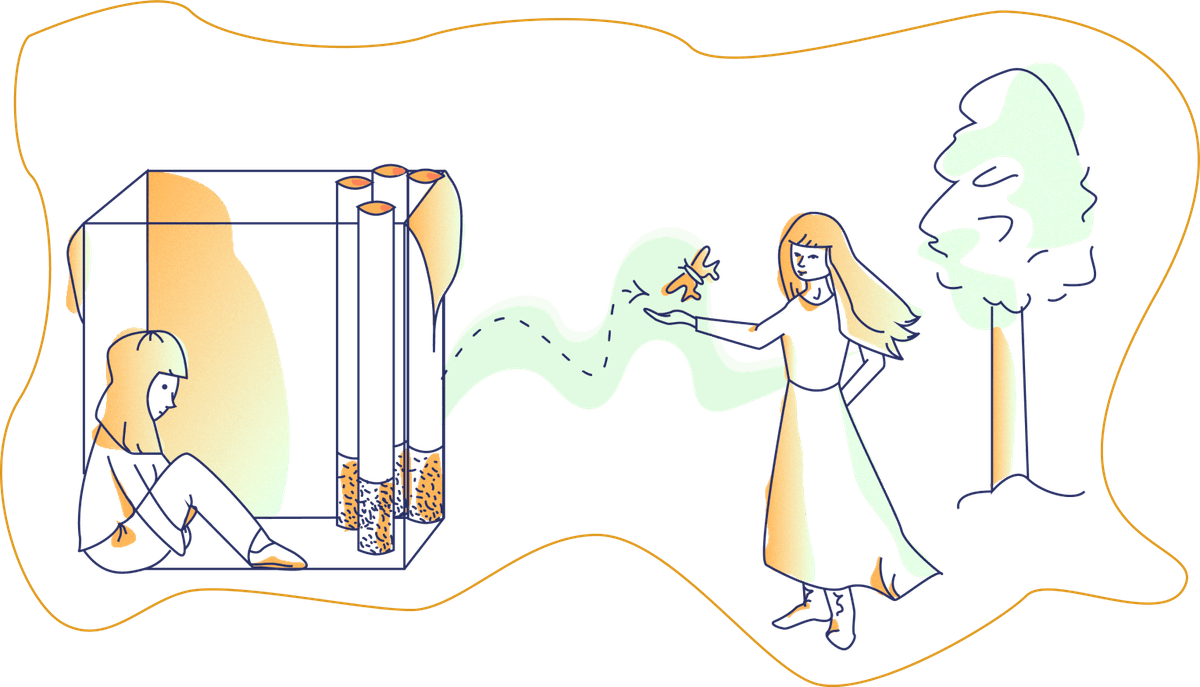
It's a challenge to stop nicotining.
We give you the most effective tools so you can help yourself throughout the way.
You'll be set in the right direction
During the registration process, we assess your habits and guide you through creating your personalized Quit Plan with the help of educational videos. We'll send it to you via email.

You can get peer support
Inside the Nekotin Quitters' Circle, you'll connect for free with others who are currently stopping nicotining, those who've already quit, and professionals who support the process.

You'll use credible knowledge
No more myths and gimmicks. Through our Education Modules, you'll learn organized knowledge and practical techniques. Everything is explained clearly and simply. Everything includes clear references for easy fact-checking. We also have a workbook!
You'll know whether medications could help you.
We'll briefly explain how these nicotine replacement and other quitting medications work and show you where to find free support to access these therapies.

Emese, your digital companion, will be with you.
Written by us. Digital, but AI-free.

Your compass
Actively helps you navigate your quitting journey.
Reasons to celebrate
Tracks your progress and sends you updates on your achievements.
To-the-point help
Supports you with short daily messages, tips, and motivation.
Up-to-date with yourself
Several times a year, helps you reflect on your quitting strategy.
Join Guided Group Sessions

A few steps, to quit for good.
Registration and Quit Planner
After registering and filling out a short survey about your current nicotine use, we'll guide you through creating your personal quitting plan with the help of educational videos.
Registration and Quit Planner
After registering and filling out a short survey about your current nicotine use, we'll guide you through creating your personal quitting plan with the help of educational videos.
Quitting Plan and Joining the Nekotin Quitting Community
We will send you a personalized plan. After you review it, you can join the community.
Quitting Plan and Joining the Nekotin Quitting Community
We will send you a personalized plan. After you review it, you can join the community.
Prepare to stop
You'll go through our educational content, which includes a lot of practical tools and some theory to help you get ready for the change.
Prepare to stop
You'll go through our educational content, which includes a lot of practical tools and some theory to help you get ready for the change.
Form a Small Group (Optional)
Within our community, you can choose to form a small group of 4–5 people to support each other throughout the quitting process. (Recommended, but not required.)
Form a Small Group (Optional)
Within our community, you can choose to form a small group of 4–5 people to support each other throughout the quitting process. (Recommended, but not required.)
Invite Supporters (Optional)
Ask your close ones to join the Nekotin Companion Program so they can help you along your quitting journey. (Recommended, but not required.)
Invite Supporters (Optional)
Ask your close ones to join the Nekotin Companion Program so they can help you along your quitting journey. (Recommended, but not required.)
Quit Nicotining
On your chosen STOP day, with the support of the Community and our services, you quit nicotine on your own terms.
Quit Nicotining
On your chosen STOP day, with the support of the Community and our services, you quit nicotine on your own terms.
Help Others Quit Too (Optional)
Eventually, you can join our alumni program and support others in their journey to quit. (Recommended, but not required.)
Help Others Quit Too (Optional)
Eventually, you can join our alumni program and support others in their journey to quit. (Recommended, but not required.)
Start your journey, become part of the community, and let's quit nicotine together. Sign up now!
Join The Nekotin Quit Program!
Let's create your Quit Plan now!

You can help your loved one to stop nicotining!
Multiple studies have shown that the chances of successfully quitting nicotine are higher when the person is surrounded by a supportive environment.4 5 6 Be that supportive environment! You can't make the decision to quit for them — but you can support along the journey. We'll teach you how to do this the right way.
No matter which stage of quitting your loved one is in, we'll help you support them through the entire journey.
Your loved one isn't even thinking about quitting yet?
Read our educational content specifically designed for this situation. We want this to reach as many people as possible, so no registration required.
Is your loved one already thinking about quitting, or just started?
We've got you covered. We're still finalizing the educational content and building the community. Register now and be the first to know when we launch!

Learn about addiction, get practical tips, and support your loved one like a pro. Sign up now!
Help others quit — with the free Nekotin Companion Program!
Let's build your Companion Plan now!
Without support, only 13% of quit attempts succeed long-term.1 Nicotine dependence has both behavioral and biological components. Willpower is important but not enough in most cases.
Behavioral counseling, cessation medications, and digital support can increase the odds of quitting successfully by up to 83%,2 individually or combined. The Nekotin program addresses all three.
Nekotin is Emese Care's digital nicotine cessation program. You get a personalized quit plan, evidence-based educational content, and access to the Nekotin Quitters Circle — a community of people quitting alongside you, plus experts.
You can request access to the program through your employer.
Emese is a digital companion character written by specialists. Not AI. She sends short daily messages to guide you through the quitting process, tracks your progress, and continuously helps you review your strategy.
Your eligibility is verified during registration, but you remain anonymous on the platform. You can use any name and a private email address after verification. Emese Care handles data in a GDPR-compliant way and does not share health data with anyone.
No, but it can help in certain cases. The Nekotin program explains how nicotine replacement and other cessation aids work, and shows you where to get free professional guidance (from a GP or specialist) on whether medication is right for you.
Nekotin supports quitting all nicotine products. Cigarettes, vaping, snus, heated tobacco, and nicotine pouches are all covered. The underlying mechanism of nicotine dependence is similar in most cases regardless of how nicotine is consumed. The program content and quit plan are designed accordingly.
Yes. The Nekotin program is available to adults aged 18 and over. You will be asked to confirm this during registration.
You can join the Nekotin program as a companion. The companion guide explains what the person quitting is going through and gives you concrete steps to help effectively. Instead of judgment or pressure, you can offer real support.